Thinking about SWASH as a community-engaged research project: the feedback

I’m writing a series of blogs about SWASH, a repeated cross-sectional survey of the health and wellbeing of community-connected lesbian, bisexual, queer (LBQ) and other non-heterosexual identifying women in Sydney. It is run by a collaboration of researchers (myself and colleague Rachel Deacon) and ACON Health (Australia’s largest community health organisation specialising in LGBTQ health). I’ve been involved for nearly a decade, but SWASH has been running as a community-engaged research project since it inception in 1996. Seriously, 22 years… that makes it an interesting case study. I’m blogging about how we do things and reflecting on why it matters that we do things the way we do. In the first blog, we had just completed the draft 2018 report and were about to present it to ACON staff. This blog is reflecting on that meeting.

Multipel covers from SWASH research reportsWe couldn’t present all the findings (we have ~50 questions) so we stuck to new questions, topics I know ACON is currently doing work around (breast health, AOD treatment service), and issues we’ve been tracking for some time (eg smoking).

New questions: this was the first time health promotion staff had access to local and timely data on suicidal ideation and self harm. We used the same questions as the Australian Longitudinal Survey of Women’s Health; the last time they reported on self harm and suicidal idealtion among LBQ women was over a decade ago. ACON have been asking for these questions for a long time. Rachel and I have said no, concerned women may not be in a safe place to deal with whatever these questions brought up – they may be answering the survey at a large community event during the day or at an evening event where they might consume alcohol or drugs. ACON asked again this year, arguing strongly that we need to normalise asking questions about mental health. Staff developed a support card to give to everyone recruited and trained the survey recruiters to be aware of these issues. And the outcome was data that could support and inform ACON’s work; high quality empirical data that could convince stakeholders of the need for targeted work. It is hard to overstate how difficult it is to get recent data on many health issues for lesbian, bisexual and queer women in Australia.

Repeated questions: We spent quite a lot of time talking about a lack of change in a health screening behaviour we’ve been tracking for several years; this behaviour is core business for ACON. SWASH captures data directly from the people ACON’s work targets, so knowing which section of the community is not engaging in screening, including women we know are at increased risk because we also have that data, can feed directly into program development. We talked about changes in repeatedly presented questions such as smoking (down) or acute psychological distress (up), and findings that need further analysis. SWASH shows how intertwined sexuality and age are; bisexual identity is more common in younger women and lesbian identity more common in older women. So knowing if variations in psychological distress are explained by age or sexuality or both is important.

A feedback session with a community-engaged organisation is valuable market testing. If there is a lot of sensitively around an issue then we can be more thoughtful how we talk about it, even work directly with staff on language. If there is a community conversation already happening, we can help advance it by adding additional narrative to the report comparing our findings to the general population, discussing the findings in relation to other LBQ studies, or link the findings to policy or program work ACON is engaged in. Self harm is a great example; our conversation made think about the language we used in the report and how important it was to acknowledge that we don’t know how respondents understand the term (the question aims to capture suicidal intent and non-suicidal intent). Do the respondents reporting engagement in sado­masochism with blood (practices such as cutting, piercing, whipping or fisting) see these practices as self-harm? It is important that we frame findings safely, meaningfully and in ways that will engage people.

A feedback session is also about solidarity and accountability. Rachel and I can make decisions that alienate, enrage, enthuse, or interest the community, but we might never hear about it. Although our contact details are readily available, I can’t recall a single email from community expressing dissatisfaction (or satisfaction!). I have very rarely been bailed up in person and my ethics committee has never received a complaint. ACON on the other hand is super accessible via social media. Staff are accessible at community events and because they are also often members of the LBQ community, people can approach them when they are ‘off the clock’. It is ACON staff who have to defend, explain or take any flack for sampling, questionnaire or analytical decisions Rachel and I make. It is important that we hear community feedback.

At our meeting we talked through methodological decisions and asked staff what they thought. For example, we’ve excluded some of our online sample for a solid methodological reason, we explained why, and discussed staff concerns about what this meant for those people who had filled in surveys. In another case, we said we can do x or y with good reasons either way, what do you think? Knowing what might be politically sensitive means we can include explanations to help community understand our decisions or the limitations of the survey, and prepare staff for community conversations. It also allows us to acknowledge the responsibilities staff as the bridge with community.

Thinking about SWASH as a community-engaged research project: the report

SWASH is a repeated cross-sectional survey of the health and wellbeing of community-engaged lesbian, bisexual, queer (LBQ) and other non-heterosexual identifying women in Sydney. It provides a snapshot, and allows us to track changes, demographics including sexuality and gender; community engagement; sexual practice, sexual partners, relationships; cervical cancer/breast cancer/STI/HIV screening, HPV vaccine uptake; smoking, alcohol and other drugs use, help seeking for AOD use; mental health, psychological service access; general health, GP satisfaction; experience of DV and anti-LGBT violence & abuse. SWASH first ran in 1996 and has run every two years since, generating data from 600-1200 respondents at each iteration. It is the longest running periodic survey of LBQ women’s health in the world.

SWASH is also a community-engaged project, run by a collaboration of researchers (Julie Mooney-Somers at Sydney Health Ethics, University of Sydney) and Rachel Deacon at (Langton Centre, South Eastern Sydney Local Health District and Central Clinical School, University of Sydney), and ACON Health (Australia’s largest community health organisation specialisaing in LGBTQ health). Let’s go back to the beginning with an extract from the very first SWASH report (circa 1998):

Nonetheless, sex with a man remains the main risk for HIV transmission to women. During 1997, 66 women were newly diagnosed with HIV infection in Australia, 58 of them through heterosexual contact and 7 through injecting drug use (Australian HIV Surveillance Report April 1998). However, it is important to remember that for a case of ‘heterosexual’ transmission of HIV to occur, neither party need be heterosexual.

There is a tendency among some clinicians, the popular media and members of the general public to assume that lesbians are by definition ‘women who do not have sex with men’, and thus to disregard any possibility of their exposure to HIV or other sexually transmitted infections. Such an assumption equates epidemiological or behavioural categories with social identities and disregards the fact that women who identify as lesbians have often had sex with men in the past and may continue to do so intermittently or even frequently, just as some gay-identified men may have sex with women. Further, because of the social circles in which they move, lesbian-identified women and other women associated with gay/lesbian/queer community who do have sex with men are more likely to have sex with homosexually active men than are women randomly selected from the community at large. If they inject drugs in the company of gay or homosexually active male friends, they are more likely to come into contact with HIV, especially if they share injecting equipment.

Both the Gay and Lesbian Injecting Drug Use Project (GLIDUP) and the Women Partners of Gay/Bisexual Men Project at the AIDS Council of NSW [now ACON] are accessed by women who are connected to Sydney’s gay and lesbian communities. Some of these women have reported having sexual contact with and/or injecting drugs with gay or bisexual men. Women also access GLIDUP’s needle exchange services at major gay and lesbian parties. Late in 1995 the Sydney Men and Sexual Health (SMASH) project released a report on men in the gay community and their sex with women (Prestage et al. 1995). This preliminary report raised issues about women in contact with the gay community which needed to be addressed more directly. These circumstances prompted project officers with GLIDUP and the Women Partners of Gay/Bisexual Men project to initiate research into the contact these women have with community-attached gay and bisexual men. The result was this survey, carried out for the first time in 1996 and again in 1998. It is based on convenience sampling and was initiated in order to estimate risks to women in contact with Sydney’s gay and lesbian community, with the primary aim of finding whether further work was necessary, either in research or targeted prevention campaigns.

SWASH came about because the community was concerned about a lack of visibility of the health issues for LBQ women and the consequences of this invisibility. Front-line community-based health workers and advocates, supported by researchers, initiated a research project to generate evidence for action. Over it’s 22 year history, SWASH has always using this model: community-based health workers and university researchers bringing their different skills, capacities, connections to a research collaboration that is characterised by a shared commitment to producing high quality relevant data to inform action. The individual (and institutional) skills, capacities, and commitments have ebbed and flowed over the time but the collaboration persisted and ever two years a survey was run. Rachel Deacon and I became ‘the university researchers’ in late 2009, taking over from Juliet Richters (and Garrett Prestage).

Being part of the SWASH collaboration for nearly a decade means I take for granted what makes SWASH special as an example of a community-engaged research project. This is the first in a series of blogs about how SWASH works (from my perspective). It would have made sense to start with the review of the survey and planning data collection, but you’ll just have to make do with me jumping into the middle: producing the SWASH report.

Some context: We collected paper survey data at events and venues in Sydney during the Sydney Mardi Gras season in February 2018, followed by an online survey. We used a professional company to data enter the surveys this year (in the past we used a casual research assistant, community volunteers or students), and it really sped things up. Their data quality processes were great so we got a very tidy data set (I highly recommend Paper House). Seven months after data collection, we have a draft report. We’ve hit this point in the cycle much earlier than usual – in large part due to the smooth data entry processes. Despite this being the 5th report Rachel and I have done, it always takes many more hours then I expect/remember to produce the report (note to self for 2020!).

Tomorrow we present the highlights of this year’s draft report to relevant front-line and policy staff at ACON through a formal feedback session. We will also have informal conversations and a few staff will undertake a detailed read. We want to know if what we have found resonates with their recent experiences with the community – for example, have they noticed a change in the drugs people are talking about using or more talk about mental health concerns. We will test out our interpretations of trends in repeated questions or findings for new questions. We will talk about how new or persistent issues connect with ACON’s policy and program work. These conversations make ACON staff aware of the findings so they can feed them in to existing or use to build new programs or advocacy. We’ve already provided early access to sexual practice data for a staff member reviewing an ACON program. We will provide feedback on where LBQ women seek support for their own alcohol and other drug use to add to an evaluation they are already undertaking of their own services. ACON asked us to include a question on mammography for the first time, as they are currently undertaking a program of breast cancer awareness.

We also talk about political and ethical issues around how we report SWASH findings – how to be careful of language so we don’t (further) stigmatise community or behaviour or inadvertently exclude people. This year we’ve changed the way we capture gender identity, using ACON’s suggested gender indicators. We will talk to staff about how to best describe who responded to the survey; this is part of continuing work on the survey itself to meet community expectations around capturing the diversity of ways people describe their experiences, practices or identities, and in some cases, their partners’ identities. When we first asked about weight and height, ACON staff expressed concern about fat stigma and normative ideas around body shape. They presented specific and well informed critiques about how BMI is mis/used and in particular how it does not recognise differences in height and weight proportions which may be related to cultural heritage. We worked together to craft language that reflected these concerns.

After nearly a decade of working together we have a report that reflects the collaboration members’ needs, values and preferences. The language and interpretations are thoughtful and grounded in community perspectives, as well as precise and technical. The final report looks professional – the ACON Design Studio transforms our WORD document into a highly polished output. The report is not a purely technical report – it has the methods and tables but too much commentary and discussion of other literature. At 50 pages it is far too long to be a community report – we have a table for every survey question, and barely any infographics.

SWASH launch photo
SWASH 2016 Report launched at LBQ Women’s Health Conference July 2017

We send hard copies of the final report to mainstream health providers, state and federal government politicians and policymakers, and community partners. We get copies deposited in the National Library of Australia, State Library of New South Wales, NSW Parliamentary Library, and University of Sydney library [because I get an ISBN]. I bring copies to any LGBT health event I attend across the country, ideally getting a copy to every conference attendee (see photo), or leaving copies at an ACON stall or under my conference poster at a mainstream conference.  My university would prefer me to put all this effort into a peer reviewed journal article, but I think the report makes a substantial practical difference to addressing the invisibility of health issues facing LBQ women and providing evidence for action.

The SWASH report is just the start as it triggers a range of community engagement activities, that’ll be the subject of my next blog.

Click here to access the published reports – and the peer reviewed journal articles 🙂


Sex and the Country Women’s Association… Community-oriented research translation for LBQ women.

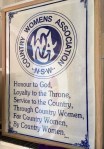
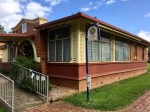
IMG_8859The CWA – Country Women’s Association are the largest women’s organisation in Australia and work to improve the conditions of women and children in the country. They’ve been around since the 1920s. They are an Australian institution no doubt, famous for their cookbooks and cake competitions. IMG_8854Their motto is all God, throne, country… For me, “the CWA” conjures up no-nonsense, white, entirely heterosexual ladies (excuse me my stereotyping). So you can imagine my surprise when I discovered my talk about lesbian, bisexual and queer women’s safer sex was to be at the Lismore CWA Tea Rooms.
Mostly, when I talk about community-engaged/community-based research it’s all about front loading: getting community involved in research development, in data collection and only occasionally in data analysis. But this community event was about research translation – telling an affected community what we have found out, giving back the knowledge we gained through them about LBQ women and sexual health. SWASH, our twenty year health survey, has generated a lot of data on sexual practice, relationships, risk practices, and screening, but it’s been a long time since we’ve shared it.

This was not a stuffy or even a shiny university research forum. The night began with some young local women singing – there was no cash, so they got paid in donated but new sex toys! There was a giant pot of tea, biscuits, and plenty of vegan and gluten-free hot food. image_542202361553653Home made signs and rainbow bunting abounded, with raunchy images from LBQ women’s safer sex campaigns stuck to the walls of the tea room. There was a table of information about local sexual health services and another table full of free viraclean for sex toys, condoms, lube, and gloves from the always awesome ILOVECLAUDE. My research finding were imperfectly projected on a bed-sheet. The lucky door prizes were sex toys and most people won something!
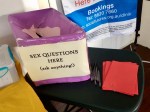
There was a lot of laughing, some whispered confessions and a lot of generosity in the room. One older woman told me about the first time she’d seen a dental dam, and her complete confusion about how exactly it would help. Another told me about the first time she’d received instruction about safer sex for sex with a woman many years ago: a bucket of warm soapy water beside the bed to wash your hands between orifices/bodies. Women talked about where to find a safe GP, where to get safer sex supplies, and how you might start a conversation with a lover about preventing STI transmission. There was a lot of frank conversation about what we do, what we know, and what we aren’t sure about. What women didn’t know or didn’t feel sure about resonated very strongly with Ruby Grant’s recent research with queer young women in Tasmania, Jen Power’s earlier work with lesbian and bisexual women in Victoria, and some of my own work with younger LBQ women in Sydney (more citations at the end of this blog). .

We had a sexual health doctor in attendance (Dr Kate Bolam from Choices Clinic) and women posted anonymous questions throughout the night for her to answer. Several questions came in response to my presentation. I doubt anyone would have asked about the risks involved in oral sex and menstrual blood except I told them three quarters of LBQ women said in the last 6 months they had performed oral sex during menstruation without a barrier (Juliet Richters published this SWASH analysis ). image_542429492779593If they’d read this in a research report, I wonder what they would have done with the uncertainty this produced for them? How would they have gotten answers to questions about their own practice – should they avoid oral sex, try to get dental dams (your best bet is ILOVECLAUDE), or use a tampon (apparently provides little protection). There is a serious dearth of good quality and relevant sexual health information for LBQ women (see citations at the end of this blog). The event gave them the means to take the research findings and apply them to their lives and their practices.

I can take little credit for the event. ACON asked me to participate. The amazing staff at ACON Northern Rivers are deeply connected community people and so could judge the level, the tone, and how to make it work for local women rather than for an out of town academic (no one in the room was likely to cite my work in peer review, there was no local dignitary to shake my hand for the local paper’s photographer, no formal evaluation. I left feeling pretty convinced that community-oriented research translation needs community partners taking the lead.

At the end of the night I realised just how appropriate it was that we held our event in a CWA Tea Room. Both the CWA and SWASH are about a group of people getting together and mustering scare resources in service of their community. Through the community, for the community, and by the community.
What do we know about LBQ women and safer sex in Australia? (let me know if you get stuck at a paywall)

Cox, Peta, McNair, Ruth (2009) Risk reduction as an accepted framework for safer-sex promotion among women who have sex with women. Sexual Health, 6:15-18.

Grant, Ruby, Nash, Meredith (2017) Navigating unintelligibility: Queer Australian young women’s negotiations of safe sex and risk. Journal of Health Psychology, 23(2): 306-319

McNair, Ruth (2005) Risks and prevention of sexually transmissible infections among women who have sex with women. Sexual Health, 2: 209-217.

McNair, Ruth, Power, Jennifer, Carr, Susan (2009) Comparing knowledge and perceived risk related to the human papilloma virus among Australian women of diverse sexual orientations. Australian and New Zealand Journal of Public Health, 33: 87–93.

Mooney-Somers, J, Deacon, RM, Klinner, C, Richters, J, Parkhill, N (2017) Women in contact with the gay and lesbian community in Sydney: Report of the Sydney Women and Sexual Health (SWASH) Survey 2006, 2008, 2010, 2012, 2014, 2016. Sydney: ACON & Sydney Health Ethics, University of Sydney.

Power, Jennifer, McNair, Ruth, Carr, Susan (2009) Absent sexual scripts: lesbian and bisexual women’s knowledge, attitudes and action regarding safer sex and sexual health information. Culture, Health & Sexuality, 11(1):67-81

Richters, Juliet, Prestage, Garrett, Schneider, Karen, Clayton, Stevie (2010) Do women use dental dams? Safer sex practices of lesbians and other women who have sex with women. Sexual Health, 7: 165–169.

Australia’s longest running regular survey of lesbian, bisexual and queer women’s health is collecting data…


Every two years since 1996 the SWASH survey has been asking lesbian, bisexual and queer women in Sydney about their sexual health, mental health, experiences of violence and abuse, tobacco and drug use, alcohol consumption, and health service engagement. In 2010, the survey started running biennially in Perth (as WWASH), and in 2014/5 we ran a one-off survey in the Illawarra-Shoalhaven region of NSW.

Data collection for 2018 is now on as part of the Sydney’s LGBTI Mardi Gras events in February. Our peer recruiters will be at over 30 events so you’re sure to bump into one! We’ll be collecting data in the Northern Rivers and Coffs Coast region throughout March (if there is an event or group for LGBTI people/LBQ women, you’ll find us) . The survey will be online throughout March; I’ll promote the online survey when we’re open for business.

SWASH began as a collaboration between researchers and community health workers at the then AIDS Council of NSW, now ACON (Australia’s largest LGBTI health promotion organisation). Since 2009, Rachel Deacon and I have been the lead researchers. It is a massive, passionate, heartfelt, exhausting and super important piece of work for me and a whole bunch of people. Did I mention it is unfunded?

I’m going to be blogging about SWASH over the coming months. I’ve been thinking about what it means to be a community-engaged project. What promises do we (implicitly?) make to community that we will ensure they can record their experiences and that we will then reflect those experiences back to them in our analyses (having so many conversations about this lately). We’re going properly online this year so that is bringing up lots of things to think about, especially methodological issue around sample claims. I am so excited that we are going to be seriously on the ground is the Northern Rivers and Coffs Coast region of NSW, and I want to blog about my experiences and post lots of pics – we’ll be holding some events (like this forum on smoking).

Check out all out the SWASH/WWASH outputs to date here https://juliemooneysomers.com/research/#SWASH

(Image supplied by ACON; features survey recruiters at Fair Day 2016).


Community forum: lesbian, bisexual and queer women and smoking.

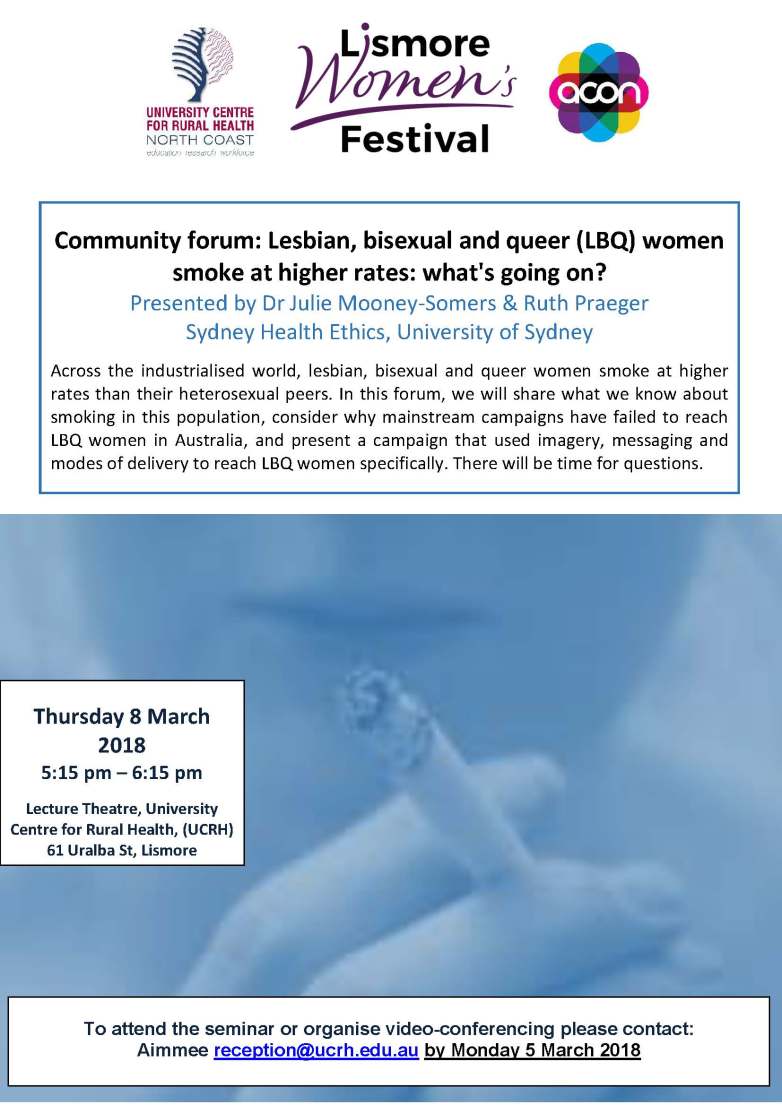
I have the honour of participating in this up coming forum at the University Centre for Rural Health in Lismore (northern NSW), co-sponsored by ACON and part of the Lismore Women’s Festival. We’ll tell you want we know, answer your questions and hang around afterwards to hear your perspectives. I’m in Lismore for a couple of events (I’ll be talking about LBQ women and sex at the Country Women’s Association Hall on the Wednesday evening…) and we’re running SWASH Northern Rivers and Coffs Coast throughout March. Come along to one or all of the events if you’re Northern Rivers based. LBQ Women and Smoking Research Seminar 08_03_2018 (002)

Lesbian and bisexual women and Pap smears – some good news but concerns remain

I attended the Australasian Sexual Health conference in Sydney to share our recent analysis of data from SWASH on Pap smear testing rates for lesbian, bisexual and queer (LBQ) women. The work was initiated by a medical student from Scotland, Catriona Douglas, who did an research internship with me earlier  this year. We looked at changes in testing between 2002 and 2012, comparisons between LBQ women and the general population in NSW, and predictors of test attendance among LBQ women in NSW. This is what we found:

Sexual Health SWASH pap smear poster FINAL print

Citation: Douglas C, Deacon R, Mooney-Somers J (2014) Pap smear rates among Australian lesbian and bisexual women: some good news but disparities persist. Poster presented at Australasian Sexual Health Conference, Sydney. Download the poster here.

We’ve just started to get some media interest.

Gay New Network (SX magazine in Sydney)


Tobacco-control project targeting lesbians, bisexual and queer women

The Cancer Institute NSW (the cancer control agency for NSW) awarded an Evidence to Practice grant to ACON (NSW’s leading health-promotion organisation specialising in HIV and LGBTI health). I’m delighted to be the research partner on the grant.

The grant is titled “Tobacco-control project targeting lesbians, bisexual and queer (LBQ) women” and will run until mid-2016. The grant was awarded on evidence from the research I’ve been doing with ACON (and colleague Rachel Deacon) in the SWASH project that shows lesbian and bisexual women in Sydney are smoking at twice the rate of their heterosexual peers, and that rates have changed little despite significant mainstream public health interventions.

This grant is a real win. It is a testament to ACON’s commitment to this area, their strategic plan for 2013-2018 outlined a range of commitments to addressing smoking in LGBTI communities, including:

“seek funding to use our considerable social marketing expertise to identify and address the current high rates of smoking in our communities.”

It is also a testament to the Cancer Institute’s responsiveness to an area that has long been neglected in Australia (compared to the US, for example). And I’ve really pleased that the SWASH survey was key to providing an evidence base for a lack of movement in smoking rates among lesbian and bisexual women in Sydney.

The project will use ACON’s expertise in community-based social marketing to develop a smoking intervention to be delivered online and through community spaces and events. Will update here as the project progresses….

Fascinating Facts about Female Same-Sex Couples from the 2011 Australian Census

You’ll think twice about the next nurse, teacher, or police officer you meet… 

Last week, more data on same-sex couples was released from the 2011 Census of Population and Housing. This is the third set of analyses released by the Australian Bureau of Statistics (ABS):

  • Same-sex couple families” part of the “Reflecting a Nation: Stories from the 2011 Census” series in June 2012.#
  • Counts of Same-Sex Couples” a census factsheet in September 2012.$
  • a media release titled “Australian Social Trends: Same-Sex Couples in Australia” released July 2013.^

Data are reported by same-sex couple versus opposite-sex couple, with an occasional breakdown by gender. Although there is not enough disaggregation by gender for my liking, I’ve put these data in green. These analyses provide some interesting insights into women living in same-sex couple relationships.

How are same-sex couples identified by the census?

Since 1996 respondents have been asked to identify the relationship of each person in the household to each other person – whether you are the husband/wife, de facto partner, child, stepchild, sibling, or unrelated. In 2011, 33,714 same-sex couples were registered, an increase of 32% since the 1996 census.^ The ABS suggests this is due to “growing social acceptance [and] increased awareness that data about same-sex couples is made available from the Census, giving more reason for same-sex couples to be open about the nature of their relationship and willing to supply this information.”$

Despite there being no marriage equality in Australia and various governments working to make sure marriages from other jurisdictions are not recognized, the ABS made a bold move* for the 2011 census and reported the proportion of same-sex partners registering their relationship as husband/wife. Prior to this, these people would have been reclassified as de facto.^  The ABS  states: “The reasons why people might report that they are the husband or wife of someone of the same sex cannot be known from Census data, but may include having been married in a jurisdiction other than Australia, having registered their relationship under state or territory law, or considering that husband or wife is the term that best describes their relationship.”^

What do the census releases tell us about women in same-sex relationships?

The number of same-sex couples in Australia in 2011

  • There were 16,131 female same-sex couples, of whom, 661 women reported their relationship as wife-wife.^
  • Same-sex partners  accounted for 0.7% of all partners (1.6% of partners aged 15–24 years).#
  • 0.9% of partner Aboriginal and Torres Strait Islander men and women were in a same-sex couple, this flattens out when you take account of age. It is worth remembering that 2.9% of all same-sex couples include an Aboriginal and Torres Strait Islander person.#
  • 0.8% of women born in Australia were living with another women.#
  • 0.5% of women born overseas were living with another women. (The most common countries of origin for women were NZ and England).#

Age differences within couples

  • The average age difference between women in a same-sex couple was 4.8 years (compared to 6.5 years between men in a same-sex couple, or 3.7 years between people in an opposite-sex couple).$
  • People in same-sex couples were in general younger than people in opposite-sex couples. The greatest number of same-sex couples were in the age group 35-44 years, followed by 25-34 and 45-54.#

Kiddies

  • 22% of female same-sex couples had children living with them (compared to 3% of male same-sex couples and 54% of opposite-sex couples).$
  • Same-sex couples who had children living with them were less likely to have two or more  (47%), compared to opposite-sex couples (64%).$

Religion

  • Same-sex couple partners were less religious than opposite-sex couples (48% compared to 21%); still 40% registered their religion as Christian (compared to 67% of opposite-sex couples).#
  • Same-sex couple partners were more likely to report their religion as Buddhism (4.0% compared with 2.6%).#

Education

  • Same-sex couple partners were twice as likely to have a Bachelor degree or higher than those in opposite-sex couples (42% compared to 23%).$
  • And more than twice as likely to have a Doctoral degree (2.3% compared to 0.9%).$

Workforce participation

  • 89% of partners in same-sex couples are in the workforce, compared with 69% of those in opposite -sex couples.$
  • Partners in same-sex couples are more likely (53% )to be in skilled occupations than those in opposite -sex couples (40%).$
  • The most common occupation for women in same-sex couples was registered nurse (4.3%), with secondary school teacher (2.2%), police (2.2%), welfare worker (2.0%), primary school teacher (1.7%) and university lecturer/tutor (1.5%) all in the top ten occupations.$

Women in same-sex couples are highly engaged in looking after the health and education of the Australian community

Income

  • Women in same-sex couples are earning more than their sisters in opposite-sex couples: three times as many earn $2000 or more per week.$
  • While women in same-sex couples are earning more than their sisters, there is still a gender pay gap: 11% of these women earn $2000 or more per week compared to 18% of men in same-sex couples and 14% of men in opposite-sex couples (and 4% of women).$

Housework

  • Women in same-sex couples shared the housework more than all other couples – 59% shared compared to 57% of male same-sex couples and 38% of opposite-sex couples.$

Geographical concentration

  • Same-sex couples are most likely to live in large cities and town – female same-sex couples account for 0.4% of couples in cities of 1million plus people.$
  • Perhaps reflecting the concentration of women in public service jobs, the greatest proportion of female same-sex couples was in ACT (0.6% of all couples in ACT), followed by… Northern Territory (0.5%; but only 0.3% of couples were male same-sex couples).$
  • While NSW had less than 4% of female same-sex couples, 34% of Australia’s female same-sex couples lived there.$

Female same-sex couples were highly concentrated in the inner west of Sydney…

  • The inner west of Sydney comprised the top ten suburbs for female same-sex couples: St Peters (6% of all couples), Newtown (5.7%), Erskineville (5.4%), Enmore (5.3%), Lewisham (4.2%), Alexandria (3.6), Tempe (3.5%), Chippendale (3.4%), Marrickville (3.2%), Stanmore (3.0%).$
  • Not to be left out, female same-sex couples made up 4.5% of couples in Daylesford-Hepburn Springs, a Victorian country town with a population of 3,200. And 1.2% of couples in Alice Springs, a central Australian town with less than 25,000 residents.$
  • 63% of people in same-sex couples had lived at a different address than at the time of the 2006 census (compared to 40% of people in opposite-sex couples).$

Who’s missing?

All the single ladies… Now put your hands up

The 2011 Australian census can only tell us about people in same-sex couples – that’s “two people of the same-sex who report a de facto or married partnership in the relationship question on the Census form” – and who are “usually resident in the same household”.# This means we have no insights into the lives of Australian:

  • Single lesbian or bisexual women
  • Single lesbian or bisexual women with children
  • Lesbian or bisexual women who are in couple relationships but who do not usually reside in the same household
  • Lesbian or bisexual women who are in relationships comprising more than two people

How is this all helpful?

Check out this great discussion paper from the national LGBTI Health Alliance on why this matters and some of the complexities around capturing accurate, useful and meaningful data about lesbian, gay, bisexual, trans/transgender, intersex and other sexuality, sex and gender diverse peoples.

I’m a social researcher working in health and I’d like to have access to reliable data on lesbian and bisexual women. I run  (with colleagues) a biennial survey of lesbian and bisexual women’s health (I’ve written several blog posts about this work). If we can use the census to work out how representative our samples are (I’ll write about this when we do it) then we can be confident about the validity and usefulness of the data we collect. And others can act on it, including those making policy that affects lesbian and bisexual women’s lives and health providers caring for their health and wellbeing. This is especially important as long as lesbian and bisexual women are not identified in national data sets. I’d love to hear about the information about lesbian and bisexual women you’d find useful for the area you work in.

Footnotes
*The fact sheet goes so far as to pointedly state: “However, there is still no Australian legislation to allow same-sex marriage or legal recognition of same-sex marriages performed overseas”.$
Data sources – The ABS has done all the hard work here, I’ve merely collated and pulled data on women. Thanks for that ABS, I really really appreciated your efforts.
$ Counts of Same-Sex Couples
Same-sex couple families. Reflecting a Nation: Stories from the 2011
Australian Social Trends: Same-Sex Couples in Australia

Homophobia in our healthcare system – Sydney Morning Herald

Homophobia in our healthcare system – a very worthwhile read from Friday’s Daily Life, Sydney Morning Herald. Written by Melissa Davey (coincidentally a student at Sydney School of Public Health), it was prompted by a very interesting research article on lesbian mothers’ experience of the healthcare system. What I especially liked about the research article is the researchers’ description of four different ways women experienced homophobia: exclusion from services and healthcare; heterosexual assumption; inappropriate questioning and outright refusal of services. I suspect they resonate for many same-sex attracted women (so not limited pregnancy).

The researchers echo a point ACON has been making for a while (indeed they cite ACON’s historic “Turning Point : Lesbian Health Strategy“):

Fundamentally, the distinctive healthcare needs of lesbian women go unnoticed, are deemed unimportant or are simply ignored

As a reminder, those distinctive healthcare needs include significantly higher rates of smoking, risky drinking, illicit drug use, psychological distress… We don’t have evidence to show the impact of some of these lifestyle risk factors (tobacco, alcohol) because NO ONE IS COLLECTING THE DATA, but we know that they are likely to produce higher rates of  cardiovascular disease, cancer, etc.

Lower rates of Pap smears in women without a history of sex with men suggest there is still education to be done. The comments on the Daily Life blog repeat myths about lesbian women not needing Pap smears. Even though the message has been pretty clear for a while:

Western Australian Cervical Cancer Prevention Program

PapScreen Victoria – although note the curious choice of ‘sexy’ imagery

Women’s Health Queensland

South Australian Cervical Screening Program

Cervical Screen NSW

ACON community forum on lesbian and gay drug trends – TUESDAY @ Oxford Hotel

Lesbian and Gay drug trends forum

Delighted to have been invited to speak at this community forum with Dr Toby and Miss Tokyo and community representatives… SWASH survey has a lot of data on alcohol, tobacco and other drug use. The main message from me will be: we need to talk about smoking… twice the rate. Still.

I’ll be interested to hear people’s sense of why this might be and – more importantly – what we might do about it. I’ll do a write up here. ACON have done a lovely design job on my slides, I’ll post them here after the forum.